If you loosen your grip on the steering wheel and your car slowly drifts left or right, something is off. Sometimes it is mild and you only notice it on long highway runs. Other times it feels like you are constantly correcting the wheel, especially when you brake.
In the UAE, this problem shows up a lot. You get long stretches of high-speed driving, heavy stop-start traffic, and summer heat that makes rubber and seals age faster. Road surfaces also get extremely hot. When the air is around 38°C, asphalt surface temperatures can climb past 60°C, and research puts summer road surface temperatures around the mid 60s in hot conditions. That extra heat changes how tyres behave, how quickly bushes soften, and how often brakes get stressed.
Here’s the thing. Many drivers (and some garages) treat pulling as a one-size-fits-all issue and go straight for wheel alignment. Sometimes that works. Sometimes it makes the car feel better for a week and then the pull returns, because the real cause was never found.
A simple way to think about it is this: a car pulls to one side when the left and right sides are no longer doing the same job. That imbalance usually comes from one of three places:
- wheel alignment and geometry
- brake drag or uneven braking force
- tyres (pressure, condition, or construction)
Suspension wear often sits in the background and makes everything worse, even if it is not the main cause.
This guide will help you separate the feel of an alignment pull from a brake pull and a tyre pull, and it will show you what a proper diagnosis should look like before anyone recommends repairs.
First, make sure it is not just the road
Before you assume the car has a fault, remember that roads are built with a slight slope (called road crown) to help water drain away. Vehicles naturally drift toward the low side of the crown. The stronger the crown, the faster the drift can feel.
In real life, it looks like this: on a dual carriageway, you might feel a gentle drift left in the left lane and a gentle drift right in the right lane on the same stretch of road. That is environmental, not mechanical, and it cannot be “fixed” with parts.
A practical test (done safely)
If you notice a mild drift on a familiar straight road, try this on a quiet, safe stretch:
- Drive in one lane for a minute and note the drift direction and effort required to keep it straight.
- When it is safe and legal, move to the adjacent lane where the road slope may be different, and note whether the drift changes direction or reduces.
- If the drift flips with the lane, road crown is a big part of what you are feeling. If it always pulls the same way with the same strength, you are more likely dealing with a mechanical issue.
This does not rule out a real fault, but it stops you chasing a problem that is mostly road shape.
The three main causes of pulling and what they feel like
1) Alignment and geometry issues
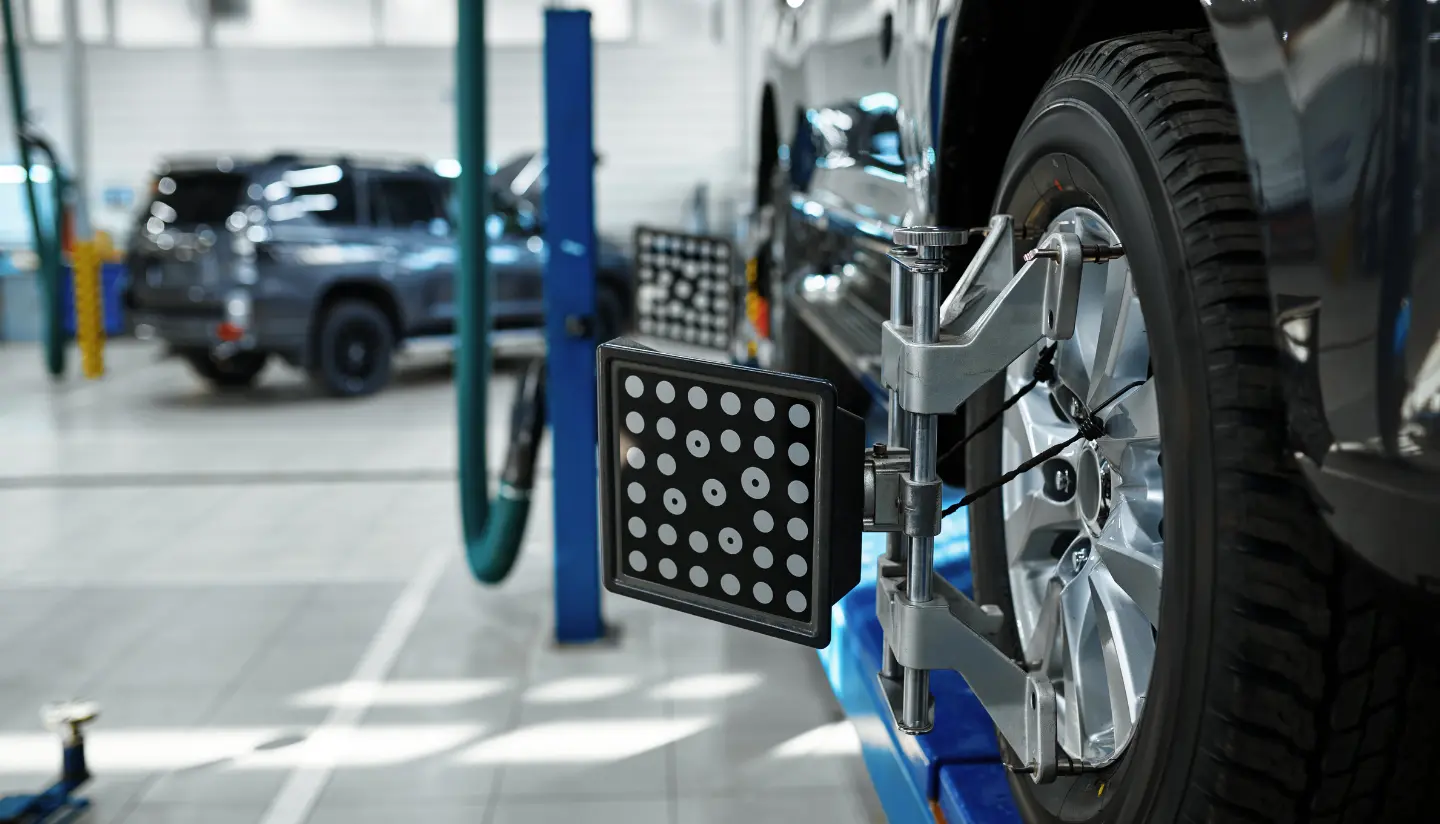
Alignment controls where the wheels point and how the tyres meet the road. When those angles are out of spec, the tyre contact patch is not balanced and the car can drift.
Typical feel
An alignment-related pull tends to be steady. It is usually there when you are cruising, and it does not suddenly get much worse the moment you touch the brake pedal.
What usually causes it
- A pothole hit that jars the suspension hard enough to shift angles.
- A kerb impact, even at parking speed, especially if it bends a steering component slightly.
- Repeated speed bump hits that gradually stress bushes and joints.
- Worn parts that let the alignment drift under load.
2) Brake drag or uneven braking
Brake drag happens when one brake does not release cleanly, so one wheel is being slowed all the time. That creates resistance on one side, and the car steers toward that side.
Typical feel
Brake-related pulling is often most obvious during braking. The car can feel fine while cruising, then suddenly tug to one side as soon as you press the pedal. If the issue is severe, you may also feel the car “holding back” slightly even when you are not braking, because one corner is constantly resisting.
3) Tyre issues
Tyres can cause pulling more often than people expect. The reason is simple: tyres are not just rubber rings, they are engineered structures with belts, sidewalls, and internal stiffness that affect how they roll.
Typical feel
A tyre-related pull can be inconsistent. It might change with road surface, temperature, or after a tyre rotation. It can also show up immediately after fitting new tyres if one tyre has a construction issue or if the front pair do not match properly.
Alignment pulling: how to spot it without guessing
Alignment problems are real, but they are also overblamed. The goal is to recognise the signs that point towards alignment before paying for repeated alignments that never stick.
Signs it is likely alignment related
- The pull is consistent at most speeds. You feel it at 60 km/h and you still feel it at 120 km/h, with the same general direction.
- It happens when you are not braking. The car drifts on a steady throttle and also when coasting.
- The steering wheel sits off-centre. You are driving straight, but the wheel is slightly turned to hold the line. Road crown can do this too, so compare across lanes as described earlier.
- You see specific tyre wear patterns. Feathering (a saw-tooth feel across the tread) is commonly linked to toe being out of spec. Goodyear notes that toe-in out of spec can cause the scuffing that leads to feathering, and that worn suspension parts can cause these angles to change while driving.
A concrete way to understand toe wear
Toe is the angle that makes tyres point slightly in or out when viewed from above. If toe is off, the tyres are not rolling cleanly, they are scrubbing.
There is a striking comparison used in alignment training and industry writing: as little as 1/8 inch of toe misalignment can create scrub equivalent to dragging a tyre sideways about 28 feet for every mile travelled. You do not need to memorise the number. The point is that small alignment errors can chew tyres quickly, especially on hot roads.
When alignment is probably not the root cause
Alignment rarely “goes bad overnight” unless something happened.
Be sceptical of alignment as the answer if:
- The pull appeared suddenly with no impact, and it is strong.
- The pull is dramatically worse during braking. That pattern points more toward brakes than alignment.
- You had an alignment recently and it returned quickly. That often means the technician aligned around a worn component or a tyre issue, and the underlying cause is still there.
- The alignment printout looks fine but the car still pulls. In that case, tyre characteristics or suspension movement may be the issue, not the numbers on the screen.
Brake drag: why it happens and why it matters
Brake drag is common in real-world driving, especially when servicing is delayed or the wrong parts and lubricants are used.
Here’s how it works: disc brakes rely on the caliper sliding freely and the piston retracting slightly. If anything sticks, the pad stays in light contact with the disc and creates constant friction.
Common causes of brake drag
- Sticking caliper piston. Corrosion or hardened seals can stop the piston moving smoothly.
- Seized slide pins. If the caliper cannot slide, one pad may stay pressed against the disc.
- Collapsed brake hose. A hose can fail internally and act like a one-way valve, keeping pressure in the caliper.
- Uneven pad wear or incorrect installation. If pads bind in the bracket, they can fail to release properly.
Brembo explains the basic physics: braking converts the vehicle’s kinetic energy into heat through friction between pad and disc. If that heat exceeds the operating limits specified by the manufacturer, the system overheats. Brake drag creates heat even when you are not actively braking, so it can push one corner into a constant overheat cycle.
Signs your pulling is brake related
- The pull is stronger under braking. The moment you press the pedal, the car tugs to one side and you have to counter-steer.
- One wheel runs much hotter. After a normal drive (not track driving, not a steep mountain descent), one front wheel is noticeably hotter than the other. Good brakes tend to run at broadly similar temperatures side to side.
- You notice a burning smell. Often after short trips with a lot of stopping, like city driving or school runs.
- Fuel economy drops over time. Drag is resistance. Resistance costs fuel. FuelEconomy.gov notes that under-inflated tyres can lower mileage, but the same idea applies to any rolling resistance: the engine has to work harder.
- Braking vibration appears. A dragging brake can overheat and contribute to disc thickness variation or warped feeling, which you may feel as vibration during braking.
A number that helps you take it seriously
Research and industry data on brake drag (often studied in fleets and heavy vehicles) shows measurable fuel penalties. One fleet-focused example reports at least a 1.5 percent increase in fuel consumption when dragging occurs part of the time. Your exact number in a passenger car will vary, but the direction is clear: drag wastes energy.
Why brake drag is not something to “live with”
Brake drag can:
- Overheat and damage brake discs and pads. This can turn a simple caliper service into a full brake rebuild.
- Accelerate tyre wear. A hot dragging corner changes tyre grip and wear, especially in summer.
- Reduce stopping performance. If one brake is already hot, it has less capacity to handle an emergency stop.
- Stress wheel bearings. Heat transfers into surrounding components.
If you mainly feel the pull during braking, it is smarter to start with brakes, not alignment.
Tyres: the pulling cause that gets missed even after new tyres
Tyres can cause pulling even when the tread looks fine. That is because pulling is not only about tread depth, it is also about tyre stiffness and uniformity.
The most common tyre causes
- Uneven tyre pressure left to right. Even small differences can make the car drift because the rolling radius and resistance change. FuelEconomy.gov notes that under-inflation affects efficiency by about 0.2 percent for each 1 psi drop in average pressure, and that keeping tyres properly inflated can improve mileage by 0.6 percent on average, up to 3 percent in some cases. The important point for pulling is not the fuel number, it is the fact that pressure changes behaviour.
- Mismatched tyres on the same axle. Different brands, models, or tread patterns can have different stiffness and “self-steer” characteristics.
- Internal belt separation or defects. A tyre can develop internal issues that are not visible, yet it will pull under load.
- Tyre conicity or uniformity issues. This is where a tyre generates a sideways force as it rolls, almost like a cone rather than a perfect cylinder. Vehicle manufacturers even publish diagnostic bulletins explaining how tyre characteristics can create lateral force and contribute to pull.
- Tyre ageing and hardening. Heat and time change rubber.
Tyre age matters more in hot climates
Many people judge tyres only by tread depth. That misses ageing.
Michelin advises keeping five years in mind, with annual professional inspections after five years of use, and says ten years from the date of manufacture is a maximum, even if the tyre looks usable. Goodyear is even stricter in its consumer guidance, saying replacement period should not exceed six years from the date the tyre is placed in service (or from the DOT date if you cannot determine when it was first put into service).
In the UAE, where tyres bake on hot roads for months each year, that guidance is worth taking seriously.
How tyre-related pulling behaves
Tyre pull often has a telltale pattern:
- It changes after rotation. If you rotate tyres and the car now pulls the other way, that strongly suggests a tyre issue rather than alignment or brakes.
- It varies with road surface. On one road it feels fine, on another it drifts more. Tyres react to texture and camber.
- Pressure changes affect it. If correcting pressures reduces the pull noticeably, tyres were part of the problem.
- Alignment readings look normal. The printout can be green, yet the car still drifts because the tyre itself is generating lateral force.
A good workshop will know how to test for this instead of selling you an alignment you do not need.
Suspension wear: the reason “the alignment never lasts”
Suspension parts hold the wheels in the right place. When bushes and joints wear, the wheel can move slightly under braking, acceleration, or cornering. That movement changes alignment angles while you drive, even if the car looked fine on the alignment rack.
Pulling patterns that suggest suspension involvement
- The pull is inconsistent. Some days it is worse, some days it is mild, often depending on speed and braking.
- It changes under acceleration or braking. The car might drift one way on throttle and another way on braking.
- There are noises. Clunks over bumps, knocks when turning, or creaks when loading the suspension.
- Tyre wear looks “patchy” or cupped. This can happen when shocks are weak or components have play.
This is why a proper diagnosis includes checking for play in ball joints, control arm bushes, tie rod ends, and wheel bearings before locking in an alignment.
A simple “when does it pull?” framework that actually works
When drivers describe pulling, they often say “it pulls all the time” even when it does not. The detail that matters is when it is strongest.
Use this simple framework:
If it pulls mostly while cruising
This points more toward:
- alignment angles out of spec
- tyre pressure differences
- tyre conicity or mismatch
- suspension geometry shifting under load
If it pulls mostly during braking
This points more toward:
- brake drag on one corner
- uneven caliper operation
- contaminated pads or uneven pad wear
- suspension bush movement under braking
If it started right after tyre work
This points more toward:
- uneven pressures
- mismatched tyres
- a defective tyre
- wheels not balanced properly (less common for pulling, more for vibration, but it can add to the feeling)
This can help if you want to explain the issue clearly to the workshop so they do not start with guesses.
What a proper diagnosis looks like (and what to avoid)
A reliable garage does not jump straight to alignment. They follow a sequence, because each step rules out a whole category of causes.
Step 1: Tyre pressures, measured cold
- Check all four tyres, not just the front.
- Compare left and right on the same axle.
- Adjust to the vehicle placard spec, not a generic number.
- Re-test drive after correcting pressures, because sometimes the “problem” is just a 4 to 6 psi split.
Step 2: Tyre condition and matching
- Inspect for uneven wear, feathering, cupping, and shoulder wear.
- Confirm the two tyres on each axle match in brand, model, size, and similar tread depth.
- Check tyre age using the DOT code, especially if the tyres have plenty of tread but feel hard. Michelin and Goodyear both flag age-based inspection or replacement windows.
Step 3: Test drive to reproduce the pull
- The technician should drive it, not just rely on your description.
- They should check whether it is worse on braking, coasting, or throttle.
- They should consider road crown effects during the test drive, because vehicles drift to the low side of the crown by design.
Step 4: Brake inspection for drag and imbalance
- Check caliper slide pins and piston movement.
- Check pad wear left to right.
- Check for signs of overheating on one side.
- Compare side-to-side temperatures after a controlled drive. Side-to-side temperature differences matter, and brake specialists note that dissimilar brake temperatures can affect balance.
Step 5: Suspension and steering play check
- Check ball joints, bushes, tie rods, and wheel bearings.
- Check ride height differences, because a sagging spring can create a pull.
- Confirm nothing is bent.
Step 6: Alignment, with a reason
Only after the above is ruled out should alignment be set and verified.
And even then, the technician should explain what they are correcting. Toe, camber, caster, and cross angles all matter. A quick “set toe and send it” is not enough if the car has a true pull complaint.
Common mistakes that waste money
These are the traps that keep people stuck in the loop of repeat visits.
Repeating alignments without fixing the cause
If alignment numbers keep drifting, something is moving or worn. Toe misalignment can scrub tyres fast, so it is tempting to keep aligning, but it is not a real fix if the underlying part is loose or bent.
Ignoring tyre match and tyre age
Two tyres that “look similar” can behave very differently. Age guidance from major manufacturers exists for a reason.
Treating brake heat as normal
Brakes get hot, yes. But one corner getting much hotter than the rest after normal driving is not “just how it is”. It is often a sign of drag.
Assuming the road is always the problem
Road crown can cause a gentle drift, but a strong pull that requires constant correction is usually mechanical. Vehicle maker diagnostic bulletins list many mechanical contributors, including tyre pressure, tyre characteristics, alignment, brake drag, and ride height differences.
When it is safe to keep driving and when to stop
Not every pull is an emergency, but some are.
Usually safe to drive short-term (but still needs attention)
- mild, steady drift that does not change much with braking
- no smells, no vibration, no unusual heat
- tyres wearing slightly uneven but not rapidly
This still costs you money through tyre wear and steering correction fatigue, but it is less likely to be an immediate safety risk.
Stop driving and get it checked urgently if you notice
- strong pulling during braking
- burning smell near a wheel
- steering wheel shudder or vibration during braking
- one wheel too hot compared to the others
- sudden severe pull that appeared overnight
The reason is simple: if a brake is dragging or a tyre has an internal defect, the situation can deteriorate quickly in hot conditions.
A quick checklist you can do before booking an inspection
This is not a replacement for a proper diagnosis, but it helps you avoid easy mistakes.
- Check tyre pressures when tyres are cold, and make sure left and right match on the same axle. Even small pressure differences change rolling resistance and behaviour.
- Look at tyre wear across the tread. If one edge is worn, or the tread feels feathered when you run your hand across it, mention it to the workshop. Toe issues can cause scuffing and feathering.
- Think about when the pull is worst. If it is mainly during braking, say that clearly because it changes the diagnostic path.
- After a normal drive, stand near each wheel and see if one corner smells hot or “sharp” compared to the others. Do not touch the wheel or disc. Heat is a clue, not a test of bravery.
- Consider tyre age if you have had the tyres for years or bought the car used. Major tyre brands warn that age matters even if tread looks fine.
If you bring these observations to a technician, you reduce the chance of trial-and-error repairs.
Final thoughts
A car pulling to one side is not a mystery problem, but it is easy to misdiagnose if you jump straight to alignment. Alignment, brake drag and tyre issues can feel similar, yet the fixes are completely different. The UAE adds extra stress through heat and driving patterns, so problems can grow faster than you expect.
What this means is: correct diagnosis saves money and reduces risk. If the pull is mild, you can usually plan an inspection soon. If it is strong during braking, involves heat or smells, or appeared suddenly, treat it as urgent.
If you want it handled properly, choose a garage that checks tyres, brakes, and suspension first, then aligns only when the mechanical side is confirmed. That is the difference between a one-time fix and an endless cycle.